Imagine you’re 80 years old.
Your driver’s license expired 56 years ago. You’ve spent more than half a century behind bars.
Now you’re free.
The city you once knew has tripled in size. Car models you’ve never seen roar past on freeways that didn’t exist when you went in. Cloverleaf interchanges twist like something out of a science fiction film.
You have no pension. No savings. Minimal Social Security.
You have to start over.
What do you do? How will you survive?
These were the questions Charles Williams (C.W.)—one of the many individuals in underserved communities served by World Impact—faced when released from prison. Thankfully, he didn’t have to face them alone.
Theologically Grounded Training Through TUMI
At World Impact, we believe that when men and women receive deep, theologically grounded training, especially in places that are overlooked and under-resourced, whole communities are transformed. That conviction is why we partner with ministries like Epiphany Life Change, where leaders are being equipped through World Impact’s The Urban Ministry Institute (TUMI) to shepherd others behind prison walls and beyond.
C.W. is one of those lives; an example of what happens when faithful partnership, rigorous biblical formation, and Spirit-driven transformation converge.
Thanks to the TUMI leadership training he received in prison, he had a spiritual mentor he could turn to: Charles Anderson, pastor and CEO of Epiphany Life Change in Houston.
Charles has walked alongside countless men, behind bars and beyond prison walls, guiding them through TUMI’s seminary-level Cornerstone curriculum. But this time, he didn’t hand C.W. a quick solution.
Instead, he handed him a process.
Exegete a Biblical Text, Exegete Your Situation
In Cornerstone, students learn to read Scripture exegetically—to slow down, ask careful questions, examine context, and trace meaning. It’s disciplined, analytical, faith-filled thinking.
So, Charles challenged C.W. to turn those same tools on his own life.
If you can exegete a biblical text, he said, you can exegete your situation. Ask questions. Examine the facts. Look for truth.
Under Charles’ guidance, C.W. began to treat his predicament as a case study, applying the higher-level thinking he had developed over four years of study to the most urgent text in front of him: his own future.
It was more than spiritual reflection. TUMI had trained him to think analytically—applying a biblical worldview to all areas of life and bringing the truth of Scripture to bear on real-world decisions.
“Prison takes away a man’s ability to make decisions. Every movement is dictated. Over time, that muscle weakens. In TUMI, we rebuild it,” said Charles. “Through case studies and exegetical thinking, men learn to step back from a problem, analyze it, and work toward a solution. We’re not just teaching Bible study. We’re restoring the capacity to think.”
Where C.W. is at Today
Today, C.W. serves as a musician at a Houston church, playing the organ with quiet confidence. “He knows the old hymns by heart,” Charles says. During the week, he delivers auto parts for a local automotive company, navigating the city with surprising ease. “He can find his way around because he remembers Houston from before the highways.”
Stories like C.W.’s are possible because faithful partners choose to invest in deep, sustained training behind prison walls. The education that reshaped his thinking did not happen by accident. It happened because someone believed men like him were worth equipping.
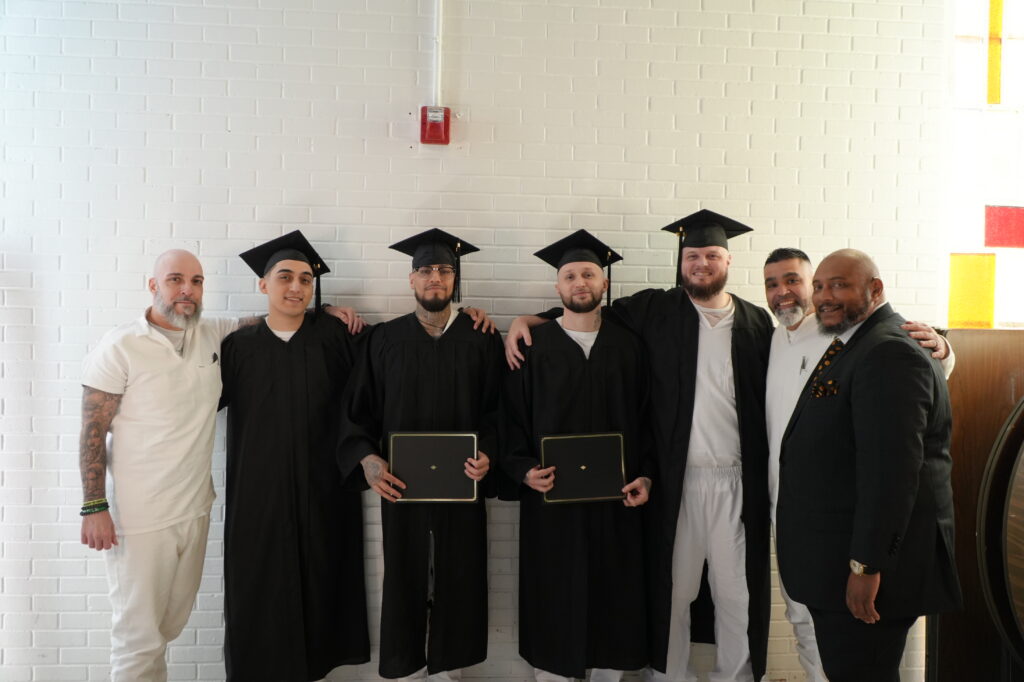
C.W., who completed the Cornerstone program while still incarcerated, is not an exception. He is one of hundreds.
More than 400 incarcerated men in the Houston area alone are currently enrolled in the same seminary-level curriculum that shaped C.W.’s second chance. Across multiple Texas prisons, behind razor wire and concrete walls, they are learning to read Scripture carefully, think critically, lead faithfully, and prepare for lives that may one day extend far beyond the prison gates.
The Transformation Isn’t Just Personal, It’s Measurable
For years, Charles and other mentors have watched men change from the inside out. The stories were compelling. Now the research confirms it: the transformation in TUMI classrooms is not only personal. It is measurable. For those who invest in this work, that matters. Faithful generosity deserves faithful evidence.
LaBarbera Learning Solutions, headed by Dr. Robin LaBarbera, conducted a multi-year, mixed-methods evaluation of TUMI programs operating inside U.S. prisons. Their research included surveys and focus groups with 266 currently and formerly incarcerated participants across multiple states.
The findings are clear: TUMI training is associated with healthier thinking patterns, including greater self-respect, clarity of identity, and confidence as leaders. Participants reported stronger impulse control, sharper problem-solving skills, and freedom from substance abuse. Relationships improved. Empathy deepened. Family and community ties were restored.
Participants scored exceptionally high on measures of psychological well-being, even when compared with groups facing significantly less adversity. That detail matters. Low well-being is a known risk factor for recidivism.
The numbers on reincarceration are just as striking. In partnership with Epiphany Life Change and the Texas Department of Criminal Justice, TUMI training has been associated with markedly lower rates of return to prison. While national recidivism rates often range from 66 to 82 percent, and state averages fall between 14 and 20 percent, TUMI graduates in these programs have demonstrated recidivism rates between 7 and 10 percent.
Lower recidivism means fewer broken families, fewer victims, and fewer taxpayer dollars spent cycling individuals back into prison. It is spiritual formation with measurable public consequence.
Epiphany Life Change: Bringing Church To Prisons
Epiphany Life Change facilitates Cornerstone and Capstone programming in 10 Texas Department of Criminal Justice (TDCJ) units. Each cohort represents dozens of future disciplers, mentors, and church leaders being formed right now.
World Impact partners with Serving USA, a foundation that has enabled many of our prison sites—like those of Epiphany—to provide leadership training to men and women who are incarcerated.
Recently, TUMI’s Capstone curriculum was added to the TDCJ’s Individual Treatment Plan, integrating theological training into the rehabilitation pathways that guide inmates’ education, treatment, and reentry preparation.
For Charles, the connection between formation and rehabilitation is not theoretical. It is lived.
“Individuals completing our classes are far less likely to return to prison, saving taxpayer dollars, reducing strain on the system, and restoring lives and families,” he says.
For many, the transformation begins long before release. And for those who support this mission, the impact extends far beyond a classroom.
Inside prison walls is where leadership starts taking root.
“If there’s a church inside a prison, and there always is, that means there are already indigenous leaders. What they need is education,” said Charles. “Most men who come to faith inside are discipled by other incarcerated believers. Volunteers may come in once a week, but the daily shepherding is happening from within. My role has simply been to equip those leaders to strengthen the church that is already there.”
Men who once organized gangs now organize study groups. Graduates disciple newer students. Responsibility is entrusted, tested, and refined long before anyone walks free.
Even then, leadership does not dissolve at the gate. Charles is gathering it to help start a church.
Building Community On the Outside
Through Epiphany Life Change, Charles is bringing these men together under one umbrella to plant a Houston church designed especially for those who first met Christ inside. For many returning citizens, he says, prison church was the first place that felt ordered, structured, and safe. It was where they learned to pray, to lead, to belong.
Now they are working to build that kind of community on the outside. The church has not launched yet, but the foundation is being laid. The team is meeting, praying, organizing, and preparing for what they hope will be their first service on Easter Sunday.
This will be a congregation led by men once counted out. A church shaped not by strategy alone, but by years of careful formation and faithful partnership.
C.W. is preparing to serve in leadership through music.
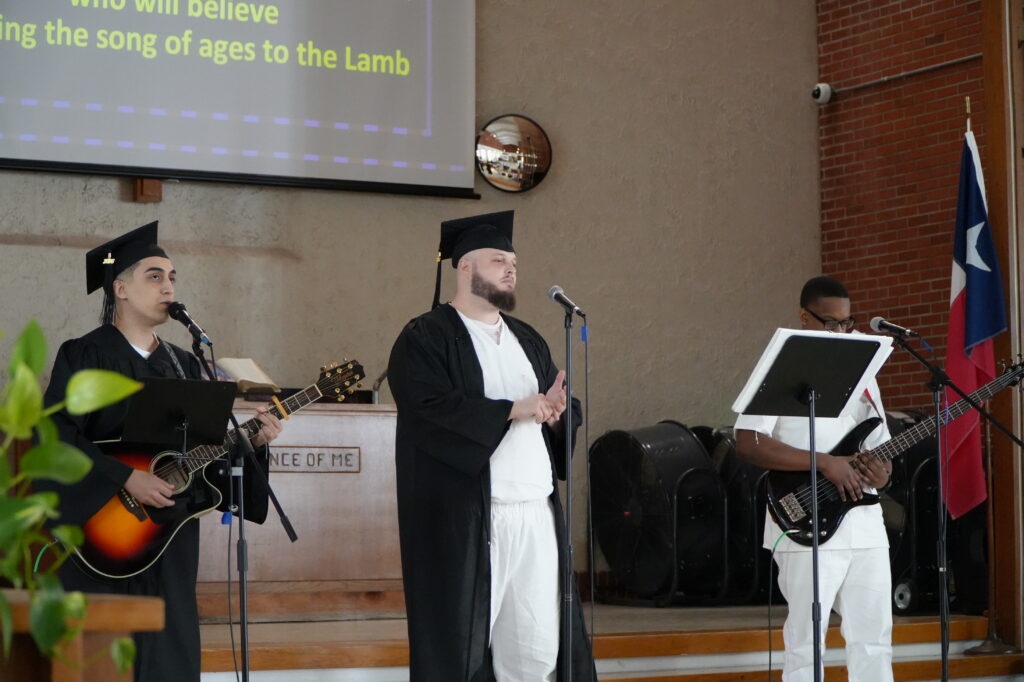
Michael, once a gang leader in Charles’ former unit and now a TUMI graduate, is stepping into an administrative leadership role.
Kevin, who was incarcerated for robbery and completed TUMI while inside, is preparing to serve as an elder.
This is not symbolic participation. It is shared authority.
The men who were formed inside are now being entrusted to lead outside, shaping a congregation that understands both confinement and freedom.
What began as Bible study inside prison walls is becoming a movement of trained leaders serving churches, families, and communities.
This is what happens when transformation is taken seriously. When education is not an event but a formation process. When supporters choose to invest not just in programs, but in people.
Also read: An Answered Prayer: Michael’s Story of Transformation
World Impact’s Prison Ministry
World Impact’s Prison Ministry is committed to multiplying this kind of leadership across the country. As part of our 2030 Missional Goals, we are prayerfully working to expand into 180 correctional institutions, equipping incarcerated believers to strengthen the Church both inside prison walls and beyond.
If you would like to learn more about our 2030 Missional Goals—including the vision for prison ministry— click here.
If you feel led to support leadership formation like this, please go to our secure donation page today.
